The red-legged partridge, Alectoris rufa, is one of the defining birds of the Spanish countryside. It lives mainly on the ground, favours varied farmland and scrub, and often runs before taking sudden, fast flight. Its red bill and legs, white throat, black necklace and barred flanks make it distinctive at close range.
For visiting hunters, learning how the bird feeds, breeds and uses the landscape makes the sporting challenge easier to understand and places responsible management at the centre of the experience. At El Despeñadero, a bird hunting lodge in Spain set on a private estate near Toledo, both the days in the field and the evenings at the lodge revolve around this remarkable gamebird.
The species at a glance
Alectoris rufa belongs to the pheasant and partridge family, Phasianidae. Its natural range lies in south-western Europe, and Spain supports a particularly important part of that range. The species has also been introduced elsewhere, including Britain. That distinction matters when reading conservation reports because an assessment of an introduced British population does not necessarily describe the condition of the bird in Spain.
It is a compact gamebird with strong legs and a rounded body. Much of its daily life is spent walking, feeding and keeping close to cover. Outside the breeding season, birds commonly gather in family groups known as coveys. When they finally take flight, they accelerate rapidly with strong wingbeats and may then glide for short distances before dropping back into cover.
| Characteristic | Typical description |
|---|---|
| Scientific name | Alectoris rufa |
| Length | Approximately 32 to 34 centimetres |
| Weight | Usually around 400 to 550 grams |
| Typical clutch | About 10 to 16 eggs |
| Incubation | Normally 23 to 24 days |
| Preferred landscape | Dry open or semi-open country with crops scrub grassland and scattered cover |
How to recognise a red-legged partridge
The clearest field marks are the red bill, eye ring and legs. The face and throat are pale and enclosed by a strong black line that breaks into dark markings across the upper breast. The flanks show curved bands of chestnut, black, white and grey. By contrast, the back is more subdued, helping the bird blend into stony ground, dry vegetation and cultivated fields.
Identification in flight depends on more than colour. Look for a rounded body, relatively short tail and direct, powerful acceleration. On the ground, the bird often runs with its head held forward. It usually flies low, although the contours of a Spanish drive and the strength of the wind can present birds much higher over the line.
Red-legged and grey partridges compared
Red-legged and grey partridges are separate species rather than different colour forms of the same bird. The red-legged partridge is Alectoris rufa, while the grey partridge is Perdix perdix. A combination of face pattern, leg colour and flank markings is more reliable than judging a bird from one feature alone.
| Feature | Red-legged partridge | Grey partridge |
|---|---|---|
| Face | White throat enclosed by a black border | Orange-brown face without the same black necklace |
| Bill and legs | Conspicuously red | More muted grey or brown tones |
| Flanks | Bold chestnut black white and grey bars | Finely patterned grey-brown sides |
| Overall appearance | Bright and strongly contrasting | More cryptic and earth-coloured |
| Scientific name | Alectoris rufa | Perdix perdix |
A hunter should establish the species before considering a shot. A brief glimpse of red is helpful, but the white throat, black border and boldly barred flanks provide a stronger identification. If the view is incomplete or the species remains uncertain, the correct decision is to leave the bird.
How a partridge differs from a pheasant
The difference between a partridge and a pheasant is easier to see. Pheasants are larger, with much longer tails, and adult males and females differ markedly in appearance. Red-legged partridges are smaller and more compact, and the sexes are harder to separate in the field. Both belong to the same wider gamebird family, but they use the landscape and respond to pressure in different ways.
Experience with driven pheasants therefore does not remove the challenge of Spanish partridge. A red-leg can change direction quickly and use the wind, slopes and folds in the ground to alter its line. Its sporting quality comes from speed and presentation rather than body size. A disciplined Gun watches the whole line, respects the safe arc and does not rush a low or uncertain bird.
Where red-legged partridges live in Spain
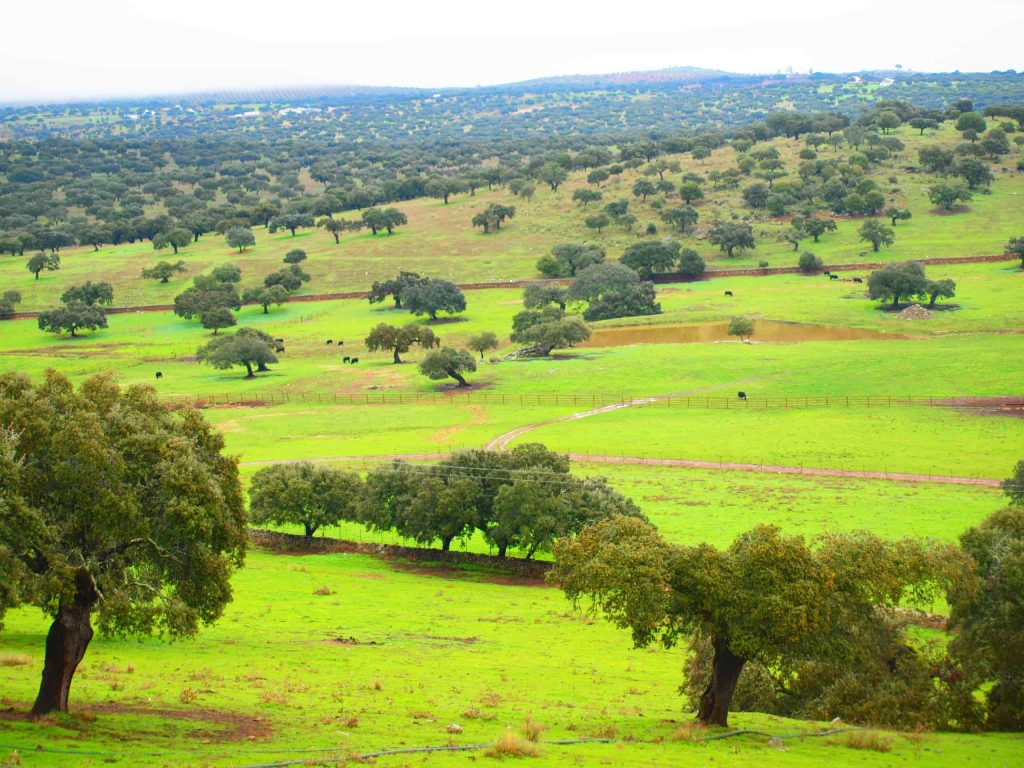
In Spain, red-legged partridges occupy open and lightly wooded country, including dry farmland, pasture, dehesa and low scrub. They do best where feeding areas sit close to nesting cover and refuge. The species occurs from lowland areas to relatively high ground, although it becomes less common at the highest elevations.
The most useful habitat is a mosaic rather than a single uniform crop. Field margins, fallow patches, cereal stubbles, olive groves, hedges and uncultivated strips each provide something different. Large, simplified fields may offer food for a short period but too little shelter, nesting cover or insect life for chicks. Habitat quality is therefore more important than the estate’s size alone.
What red-legged partridges eat
Adult birds eat mainly plant material, including seeds, leaves, shoots and roots, while also taking insects and other small invertebrates. Young chicks have different nutritional needs. During their first weeks, insects provide the concentrated protein required for rapid growth, so a landscape that appears rich in grain may still be poor brood-rearing habitat if it supports too few invertebrates.
Food availability changes through the year. Stubbles and field edges can supply seeds and green material after harvest, while spring and early-summer vegetation supports the insects needed by broods. Supplementary feed and water can form part of an estate’s management, but neither replaces varied habitat, secure nesting cover or sensible decisions about shooting pressure.
Breeding and the first weeks of life
Pairs normally form towards the end of winter. The nest is a shallow scrape on the ground, lined with vegetation and concealed among crops or natural cover. Spanish ornithological sources place most laying in April and early May. A typical clutch contains 10 to 16 eggs, although wider ranges have been recorded, and incubation generally takes 23 to 24 days.
The chicks are precocial, which means they leave the nest soon after hatching and follow the adults. They can make short flights at a young age, but remain vulnerable for much longer. Successful breeding therefore requires more than an undisturbed nest: the brood also needs insects, nearby shelter and protection during the weeks after hatching.
Behaviour that matters on a sporting day
A red-legged partridge often tries to create distance on foot before flying. Coveys use tracks, slopes, field edges and patches of cover, and birds become wary when an approach is repeated. Once airborne, wind can add speed or shift the line very quickly. A following or crosswind may turn an apparently simple presentation into a demanding shot.
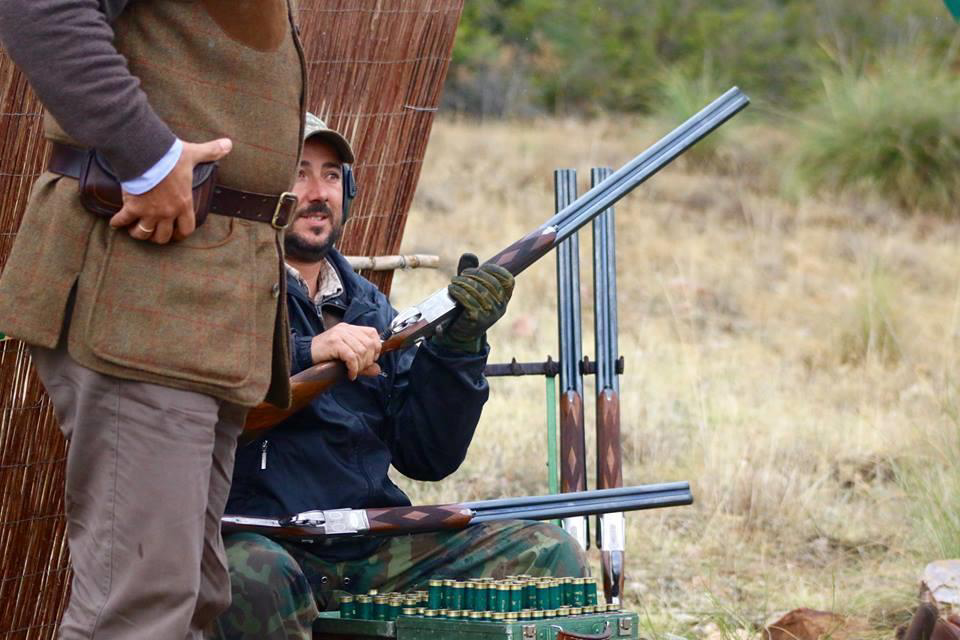
During a driven day, the Guns remain at their assigned pegs and follow the host’s instructions. Beaters use the shape of the ground to present the birds towards the line. Behind the Guns, pickers-up and trained dogs locate and retrieve shot or wounded partridges. At El Despeñadero, the dogs’ role is recovery and welfare; they are not used by each Gun to search for quarry in front of the peg.
Conservation status and principal pressures
Conservation labels need to be read at the correct geographic scale. The species is treated globally as Least Concern, while European assessments have identified it as Near Threatened. In Spain, the 2021 Red Book of Birds classifies the red-legged partridge as Vulnerable. Those descriptions use different areas and assessment systems, so they are not mutually exclusive.
SEO BirdLife reports a substantial long-term decline in Spain. Important pressures include the loss and simplification of farmland habitat, intensive agricultural practices, poorly adjusted shooting pressure and problems associated with large-scale releases. Hybridisation with chukar or other non-native stock is also a concern because it can reduce the genetic integrity of wild Alectoris rufa populations.
What responsible partridge management involves
A large autumn count does not by itself prove that wild breeding is healthy. Released birds can affect what is seen later in the year, so managers also need information on spring pairs, brood productivity and survival. The central question is whether the ground supports successful reproduction and retains birds between seasons.
- Protect nesting and brood-rearing cover throughout the year.
- Maintain field margins scrub fallow ground and other habitat variety.
- Support insect availability for chicks and limit unnecessary pesticide pressure.
- Set shooting pressure according to reliable counts and breeding performance.
- Apply suitable health and genetic controls wherever birds are reared or released.
- Use trained pickers-up and dogs to recover shot or wounded birds promptly.
A long-term Spanish project reported by the Game and Wildlife Conservation Trust illustrates the value of combining measures. Following habitat improvements, supplementary feed and water, lawful predator management and voluntary restraint on shooting, bird counts were more than four times higher and breeding productivity more than doubled during the first five years. The result came from coordinated management rather than one isolated intervention.
To learn how this species is presented on a traditional Spanish estate, explore El Despeñadero’s driven partridge shoots in Spain. For availability and a programme tailored to your party, contact the estate team.
Frequently asked questions
Is the red-legged partridge native to Spain
Yes. Spain lies within the natural south-western European range of Alectoris rufa. References describing it as non-native generally concern introduced populations in countries such as Britain.
Can a red-legged partridge fly well
Yes. It is capable of fast and powerful flight over short distances. It spends much of its time on the ground and often runs before flushing, but its sudden acceleration and changing line make it a challenging sporting bird.
How many eggs does it lay
A typical clutch contains about 10 to 16 eggs, although smaller and larger clutches have been recorded. Incubation normally lasts 23 to 24 days.
Is it the same species as a chukar
No. The red-legged partridge is Alectoris rufa and the chukar is Alectoris chukar. They are related but distinct species, and hybridisation is an important conservation concern.
Sources
- SEO BirdLife species account Spanish distribution habitat diet breeding and national conservation status.
- British Trust for Ornithology bird facts Taxonomy clutch size incubation and identification context.
- RSPB identification guide Measurements appearance and field marks.
- BTO grey partridge facts Comparison species taxonomy and identification context.
- GWCT conservation project in Spain Results from a long-term Spanish management programme.